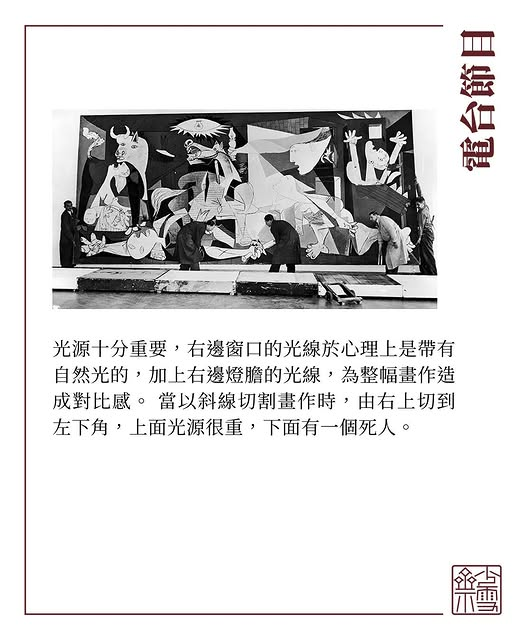
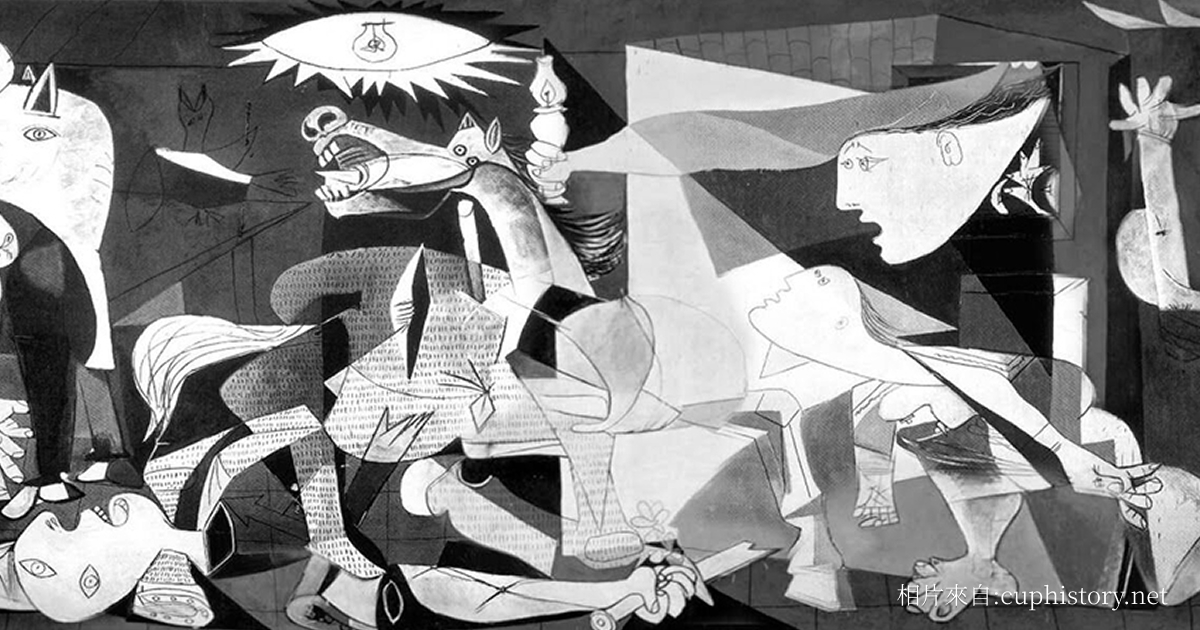

This episode continues to explore the fundamental elements within artworks. Understanding these elements will help us appreciate the balance and order in compositions. Picasso’s masterpiece Guernica was created during the Spanish Civil War. The painting is exceptionally large in size and, when viewed along its vertical axis, can be divided into six panels. These six panels appear similar, each emphasizing contrasts between light and shadow. The left side seems visually heavier, while the right side appears lighter.
Lighting is extremely important. The light from the window on the right psychologically suggests natural light, and together with the light from the lightbulb on the right, it creates a sense of contrast throughout the painting. When the painting is divided diagonally from the top right to the bottom left, the upper part is heavily illuminated, while below lies a dead person. Placing death and the light of life on the same axis is a clever compositional design. On the left, the lines of the bull’s body extend from the top left to the bottom right. The lines of the horse’s body beside it and the body of the figure on the ground actually form a straight line, creating a natural sense of balance. Light and death form a philosophical implication.